
Fence Contractor Google Ads: Real Cost Per Lead Numbers for 2026
July 3, 2026 · The Valley Marketing Group
If you run a fence installation company and you're wondering whether Google Ads is worth the spend, the short answer is yes — but the details matter a lot. Here's what the numbers actually look like and what can blow up your campaign before it starts.
Fence contractors sit in a unique spot in the home services market. Your average job value is high, your customers comparison shop, and your busy season is compressed. That combination means Google Ads can work incredibly well — or it can drain your budget fast if the campaign isn't built right.
What Google Ads Actually Costs for Fence Companies
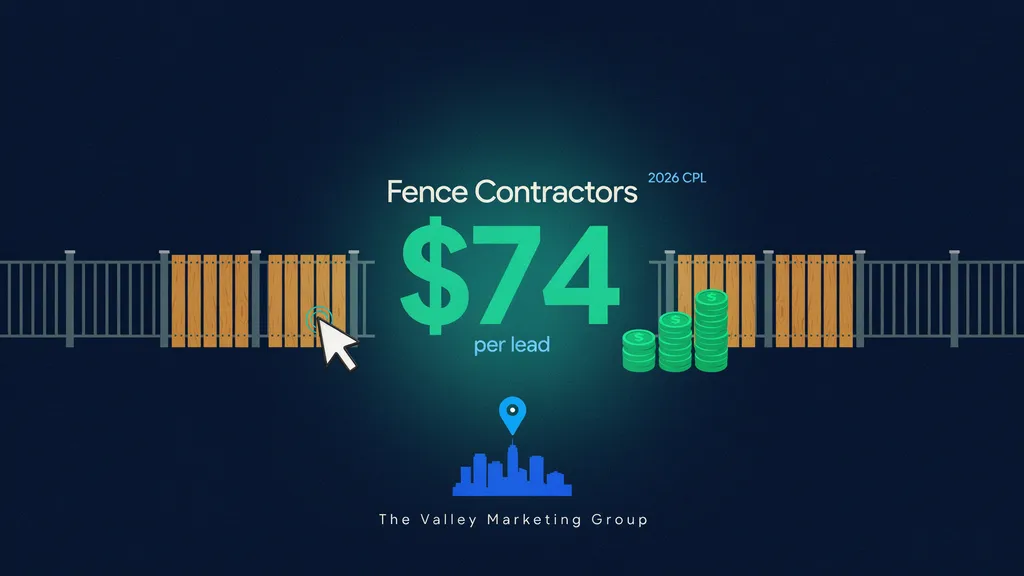
According to Andrew Ryan Marketing, which tracks fence contractor ad performance, Google Search Ads typically run $25–$75 per lead for fence contractors in season, depending on market competition and how well the campaign is managed. Built Right Digital puts the range at $45–$85 for less-optimized campaigns.
Here is how the main channels compare:
- Google Search Ads: $40–$75 per lead (optimized campaign, in season)
- Google Local Services Ads (LSA): approximately $71 per lead, per Fence Marketing Xperts
- Facebook/Instagram Ads: approximately $23 per lead — cheaper, but intent is much lower; expect more tire-kickers and unqualified contacts
Why the Math Works Even at $75 Per Lead
The reason Google Ads makes sense for fence companies is the ticket size. According to Neutrino Marketing's 2026 fence company guide, the average residential fence installation generates $4,000–$12,000 in revenue. Even if you close 1 in 4 paid leads — a conservative estimate — you are spending $300 to acquire a $6,000+ job.
That is a 20x return on ad spend before factoring in materials and labor margins. The math holds up. The problem is almost never the channel. It is the campaign setup.
What Monthly Budget You Actually Need
This is where most fence companies make their first mistake. They put $300–$500 per month into Google Ads, collect a few random clicks, and decide it does not work. According to WebTheory PPC, fence contractors who see real results typically spend $3,000 or more per month on ad spend. Barrier Boss USA's 2026 lead gen guide puts the entry point for smaller markets at $750–$1,500/month — enough to generate data but not much to optimize with.
Rough budget framework by market size:
- Small market (city under 150K people): $1,000–$1,500/month to start
- Mid-size metro: $2,000–$3,500/month
- Large competitive metro (Phoenix, Dallas, Atlanta): $3,500–$6,000/month
Below $750/month, you will not get enough clicks to learn anything useful. You cannot optimize what you cannot measure, and at that spend level, the data takes months to accumulate. Most campaigns declared dead were just starved of budget before they had a chance to run.
The Keywords That Kill Your Budget
Every fence contractor wasting money on Google Ads is burning it on the same keywords. Add these as negatives immediately:
- "How to build a fence" / "DIY fence": pure do-it-yourself intent — these people are not hiring anyone
- "Fence panels" / "fence boards" / "fence posts": material buyers heading to Home Depot or a lumber yard
- "Fence ideas" / "fence designs": early research stage, no purchase decision made
- "Cheap fence" / "cheapest fence": price-floor shoppers who will not accept a professional installation quote
- "Fence permit": often people who already hired someone and are pulling their own permits
Your Search Terms report is the most important report in your Google Ads account. Review it weekly for the first 90 days and add negatives relentlessly. If you want this handled automatically, our Google Ads AI agent monitors search terms and adds negatives on a rolling basis — so you stop paying for irrelevant clicks while you are out quoting jobs.
Want more like this?
Get our monthly newsletter — real marketing tips for service businesses. No fluff, unsubscribe anytime.
Ready to talk now? Get a free 24-hour audit instead →Google Search Ads vs. LSA: Which to Start With
If you have not run Google Ads before, start with Local Services Ads. You pay per verified lead, not per click, and Google's trust badge does some persuasion work for you. LSA is also simpler to manage — no keyword lists, no Quality Scores to worry about in the early going.
The downside is less control. Google decides which searches trigger your ads, and you cannot write your own ad copy. Once you have 20+ LSA leads and know your close rate and average ticket, layer in Google Search Ads for the highest-intent queries: "fence installation [city]", "[fence type] fence contractor near me", "fence company [city]".
Running both simultaneously is a solid strategy for established fence companies — LSA for broad lead capture, Search Ads for high-intent queries where you control the message. For a full comparison of when to use each, see our post on LSA vs. Google Search Ads for service businesses.
What Your Landing Page Has to Do
Your ad is half the equation. The landing page is the other half — and it is where most fence company ad budgets quietly disappear. A fence contractor landing page that actually converts needs, in priority order:
- A clickable phone number visible at the top without scrolling, especially on mobile
- Real photos of jobs you have completed locally — not stock images
- A quote form with 3 fields max: name, phone number, and "What type of fence?" — nothing else
- Your service area and city name visible on the page, which also helps Google Ads Quality Score
- Social proof: your Google review count and average rating
- Page load time under 3 seconds — run PageSpeed Insights if you have not done it recently
If your bounce rate is over 70% and you are not getting calls, the landing page is the problem. Read our breakdown of why service business websites stop converting for a diagnostic checklist you can run yourself.
When to Push Budget and When to Pull Back
Fence installs are seasonal in most markets. Spring (March through May) and fall (September through November) are your peaks — homeowners want fences before summer entertaining season or before winter. In warm-climate markets like Phoenix or Austin, the window is longer, but demand still softens in peak summer heat when outdoor projects slow down.
A practical budget calendar:
- March through May: Full budget plus 20–30%, bid aggressively on top keywords
- June through August: Maintain or reduce 15–20% in hot markets; shift focus to fence repair and smaller projects
- September through November: Push hard — this is often equal to or better than spring
- December through February: Cut to maintenance level, run retargeting for people who requested quotes but did not sign
Most fence companies either under-invest in their two good seasons or keep spending at full rate through slow months and run out of budget when demand picks up. Both mistakes cost real jobs.
If your Google Ads campaigns are not generating leads at a cost that makes sense, or you are not sure what is breaking, our team offers a free 24-hour audit that pinpoints exactly where you are losing money and what to fix first.
Want to know what is actually broken on your site?
We audit your website, your Google Business Profile and your ad account, then send you a written report inside 24 hours. No pitch, no pressure — you get the plan whether you hire us or not. Start your free audit, see what we charge, or call (623) 343-3141 and talk to a person.
We are based in Phoenix and work with service businesses across the Valley — Mesa, Gilbert, Chandler, Tempe, Scottsdale and Phoenix.
Sources
- Andrew Ryan Marketing — Fence Contractor Advertising
- Built Right Digital — Google Ads for Fence Companies
- WebTheory PPC — How Much Should a Fence Company Spend on Google Ads?
- Neutrino Marketing — Fence Company Marketing Guide 2026
- Fence Marketing Xperts — Fence Google Ads
- Barrier Boss USA — Fence Installer Lead Gen Secrets 2026
Everything Valley Does
AI marketing agents and full website builds — all under one roof.
Serving service businesses across the Phoenix Valley
Free tools
How Valley Can Help
We Help Businesses Like Yours Get More Leads — and Close More of Them
The Valley Marketing Group is a Phoenix-based marketing agency specializing in AI-powered lead generation, paid advertising, and web development for local service businesses.
- Google Ads & paid search — campaigns built to generate qualified leads, not just clicks
- AI phone receptionist — never miss a call or lead while you're on the job
- Website design & development — WordPress, Webflow, Shopify, WooCommerce
- SEO content & local search — rank for the searches your customers are already making
Google Ads Causing Trouble?
We'll look at your Google Ads account for free and show you where budget is being wasted, what needs fixing, and where the best opportunities are.
No generic report. No obligation.
Get My Free Audit