Dental Practice Google Ads: Real Cost Per Lead in 2026
July 5, 2026 · The Valley Marketing Group
Dental practices are in an unusual position with Google Ads: the cost per click is relatively moderate, the conversion rates are solid, but most practices still don't track whether those leads actually become seated patients. If you don't close the loop from ad click to booked appointment to showed-up patient, you don't actually know what Google Ads costs you per new patient — which means you can't make a smart decision about budget.
Here's the full cost picture for dental Google Ads in 2026, broken down by service type, what Phoenix-market practices actually spend, and what budget produces a real new-patient pipeline rather than a pile of leads that never book.
The Baseline Numbers: CPC and CPL for Dental in 2026
According to PPC Chief's 2026 industry benchmark data, the average cost per click for dental and dental services keywords is $7.85. That's the national average across all dental search terms. For comparison, roofing averages $10.25 and HVAC averages higher — dental is actually one of the more affordable healthcare categories to advertise in on a per-click basis.
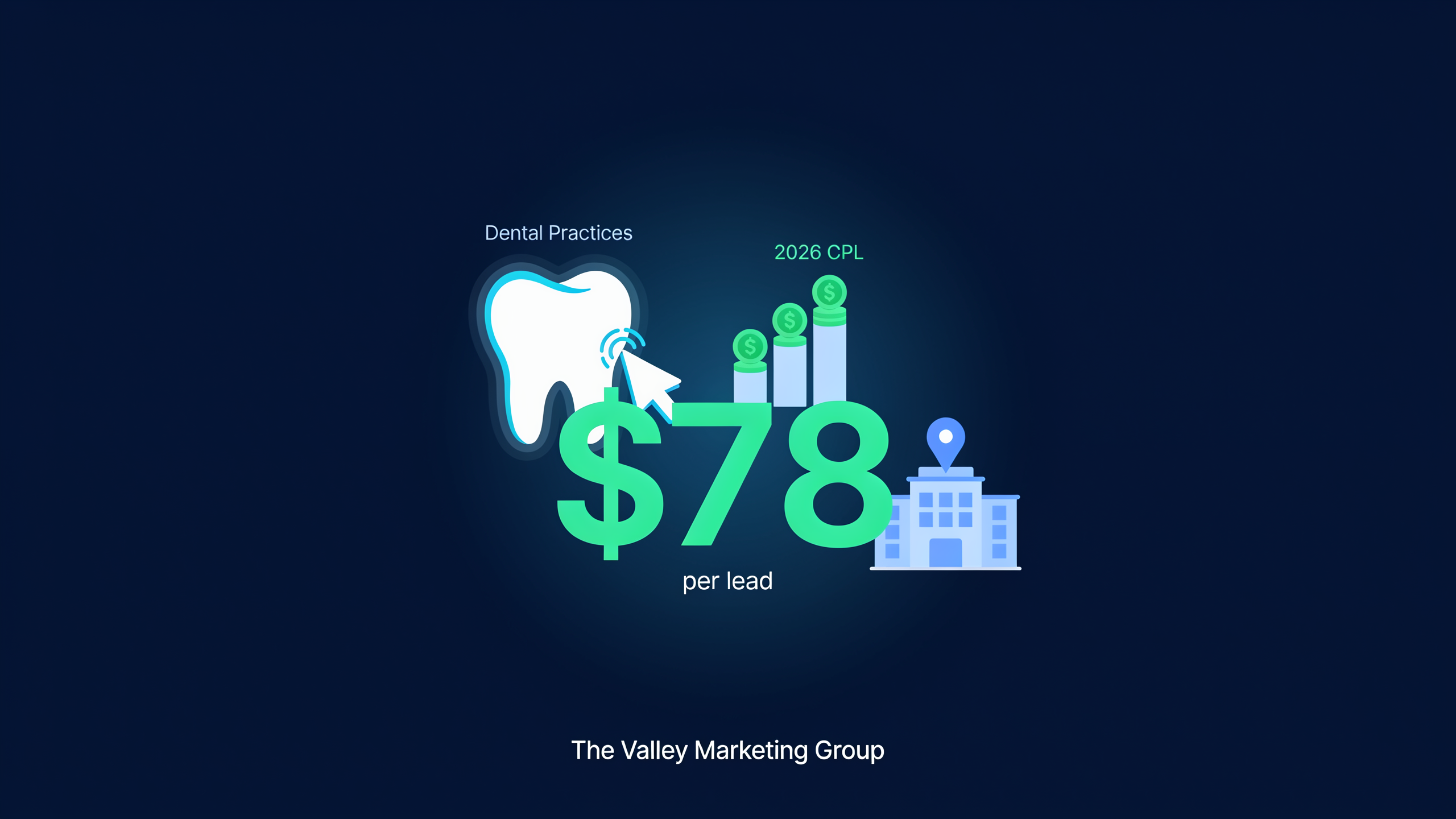
The average cost per lead for dental Google Ads runs $50–$84 depending on campaign optimization, per benchmarks from ROA Marketing's 2026 dental PPC analysis and Keygrow's dentist Google Ads cost breakdown. Well-managed accounts on general dentistry terms land around $50–$65 per lead. Underoptimized accounts or very competitive markets push toward $84 and above.
Monthly budget benchmarks from WebFX's dental PPC guide: most general practices spend $1,500–$3,000/month to see consistent results; practices in competitive metro areas like Phoenix, Scottsdale, or Tempe often need $3,000–$5,000/month to maintain visibility across general and specialty keywords simultaneously.
Implants vs. General Dentistry vs. Invisalign: The Cost Difference Is Significant
Not all dental keywords are created equal. The cost per lead changes dramatically depending on the service you're advertising. Here's how the major categories break out:
- Dental implants: Average CPC of $12, conversion rate around 7%, which produces a cost per lead of approximately $171. High-ticket service, high competition, high CPL — but a single implant case worth $4,000–$6,000 makes the math work easily.
- Invisalign and orthodontics: Average CPC of $6.50, conversion rate around 9%, producing a cost per lead of approximately $72. Strong combination of moderate cost and above-average conversion because the buyer already knows what they want.
- General dentistry: CPC range of $3–$8 depending on keyword specificity, with CPLs in the $50–$65 range for well-run campaigns. Lower individual case value but high lifetime patient value makes this worthwhile for practices building their patient base.
- Emergency dental: CPCs can spike to $15–$25 because intent is extremely high and the search-to-call timeline is minutes, not days. These leads close at a higher rate but cost more to generate.
The implication: your Google Ads budget and structure should reflect which services you most want to grow. A practice trying to build implant volume needs a higher budget and different campaigns than one focused on new patient general exams. Mixing them into one undifferentiated campaign is the most common mistake we see in dental Google Ads accounts.
Why Conversion Tracking Fails Most Dental Practices
The dirty secret of dental Google Ads: most practices track form submissions as conversions and call it a day. The problem is that form submissions are a terrible proxy for new patients. Here's what actually happens after a form submission:
- A percentage of form leads never get called back within 24 hours.
- A percentage who do get called can't be reached or schedule an appointment at an offered time.
- A percentage who schedule don't show up.
If your true show rate from Google Ads leads is 40% (a realistic number for many practices), and you're paying $84 per lead, your actual cost per seated new patient is over $200. That's still profitable at most service levels, but you're making budgeting decisions based on $84 when the real number is $200+.
The fix: push conversion data back to Google Ads from your practice management software. Track actual appointments booked and patients seated, not just form fills. Our CRM automation agent closes this loop by tagging every lead from its source all the way through to appointment completion, so you know your real cost per new patient, not just your cost per click.
The New Patient Lifetime Value Calculation
Dental is unusual among service businesses because of patient lifetime value. A patient who comes in for a cleaning and stays with your practice for 10 years — two cleanings per year, occasional x-rays, fillings, maybe a crown — generates $8,000–$15,000+ in revenue over that period, even without any specialty work.
This changes the math on what you should be willing to spend per new patient. If the average lifetime value of a retained patient is $10,000, paying $200–$300 for a new patient acquisition through Google Ads is a 33–50x return over the relationship. Most service businesses would kill for that LTV ratio.
The practical implication: don't optimize dental Google Ads just for first-visit cost. Optimize for patient retention rate at the 12-month mark. A practice with a 70% one-year retention rate gets dramatically more value from every Google Ads lead than a practice with 40% retention, even at the same CPC and CPL.
Our AI appointment scheduling agent and follow-up sequences are built to reduce the no-show rate and increase return-visit rates — both of which multiply the ROI on every new patient you acquire through paid search.
Want more like this?
Get our monthly newsletter — real marketing tips for service businesses. No fluff, unsubscribe anytime.
Ready to talk now? Get a free 24-hour audit instead →What a Well-Run Dental Google Ads Account Looks Like
A properly structured dental Google Ads account in 2026 has:
- Separate campaigns by service line: General dentistry, implants, Invisalign, emergency, cosmetic — each with its own budget, landing page, and conversion tracking.
- Conversion tracking tied to appointments, not just form fills: Form submissions are an input, not an outcome. Track the outcome.
- A negative keyword list that filters out insurance-only searches, job seekers (dental assistant jobs, dental hygienist jobs), academic searches (dental school), and out-of-market searches.
- Call tracking numbers for every campaign so phone leads are attributed correctly.
- A landing page for each service rather than sending all traffic to your homepage. A patient searching for dental implants should land on an implant-specific page with implant testimonials, not a general "Welcome to Our Practice" page.
Most dental practices that say "Google Ads doesn't work for us" are running a single general campaign, sending traffic to their homepage, and tracking form fills as their only conversion metric. That's not Google Ads failing — that's a campaign structure problem.
Your 30-Day Checklist Before Scaling Budget
- Audit your current conversion tracking: are you tracking form fills only, or actual appointments booked?
- Check whether your campaigns are separated by service line, or if you're mixing implants and cleanings in one campaign.
- Verify your landing pages match the service being advertised. Each service line should have its own page.
- Set up call tracking numbers for each campaign source.
- Calculate your actual cost per seated patient using your practice management data from the last 90 days, not just Google Ads conversion numbers.
If you want a line-by-line audit of your dental practice's Google Ads setup — what it's actually costing you per new patient and what to fix before spending another dollar — that's exactly what our free 24-hour audit covers. Book it at /contact.
Want to know what is actually broken on your site?
We audit your website, your Google Business Profile and your ad account, then send you a written report inside 24 hours. No pitch, no pressure — you get the plan whether you hire us or not. Start your free audit, see what we charge, or call (623) 343-3141 and talk to a person.
We are based in Phoenix and work with service businesses across the Valley — Mesa, Gilbert, Chandler, Tempe, Scottsdale and Phoenix.
Sources
- PPC Chief — Average CPC for Dentists and Dental Services Google Ads 2026
- ROA Marketing — Dentist Google Ads Cost Per Click 2026: Dental PPC Benchmarks
- Keygrow — How Much Does Google Ads Cost for Dentists? (2026 Data)
- WebFX — PPC for Dentists in 2026: Cost, Strategy and ROI Guide
- The Ad Spend — Google Ads Benchmarks for Dental 2026
Everything Valley Does
AI marketing agents and full website builds — all under one roof.
Serving service businesses across the Phoenix Valley
Free tools
How Valley Can Help
We Help Businesses Like Yours Get More Leads — and Close More of Them
The Valley Marketing Group is a Phoenix-based marketing agency specializing in AI-powered lead generation, paid advertising, and web development for local service businesses.
- Google Ads & paid search — campaigns built to generate qualified leads, not just clicks
- AI phone receptionist — never miss a call or lead while you're on the job
- Website design & development — WordPress, Webflow, Shopify, WooCommerce
- SEO content & local search — rank for the searches your customers are already making
Google Ads Causing Trouble?
We'll look at your Google Ads account for free and show you where budget is being wasted, what needs fixing, and where the best opportunities are.
No generic report. No obligation.
Get My Free Audit