
AI Voice Receptionist for HVAC and Plumbing: The Missed Call Math
June 21, 2026 · The Valley Marketing Group
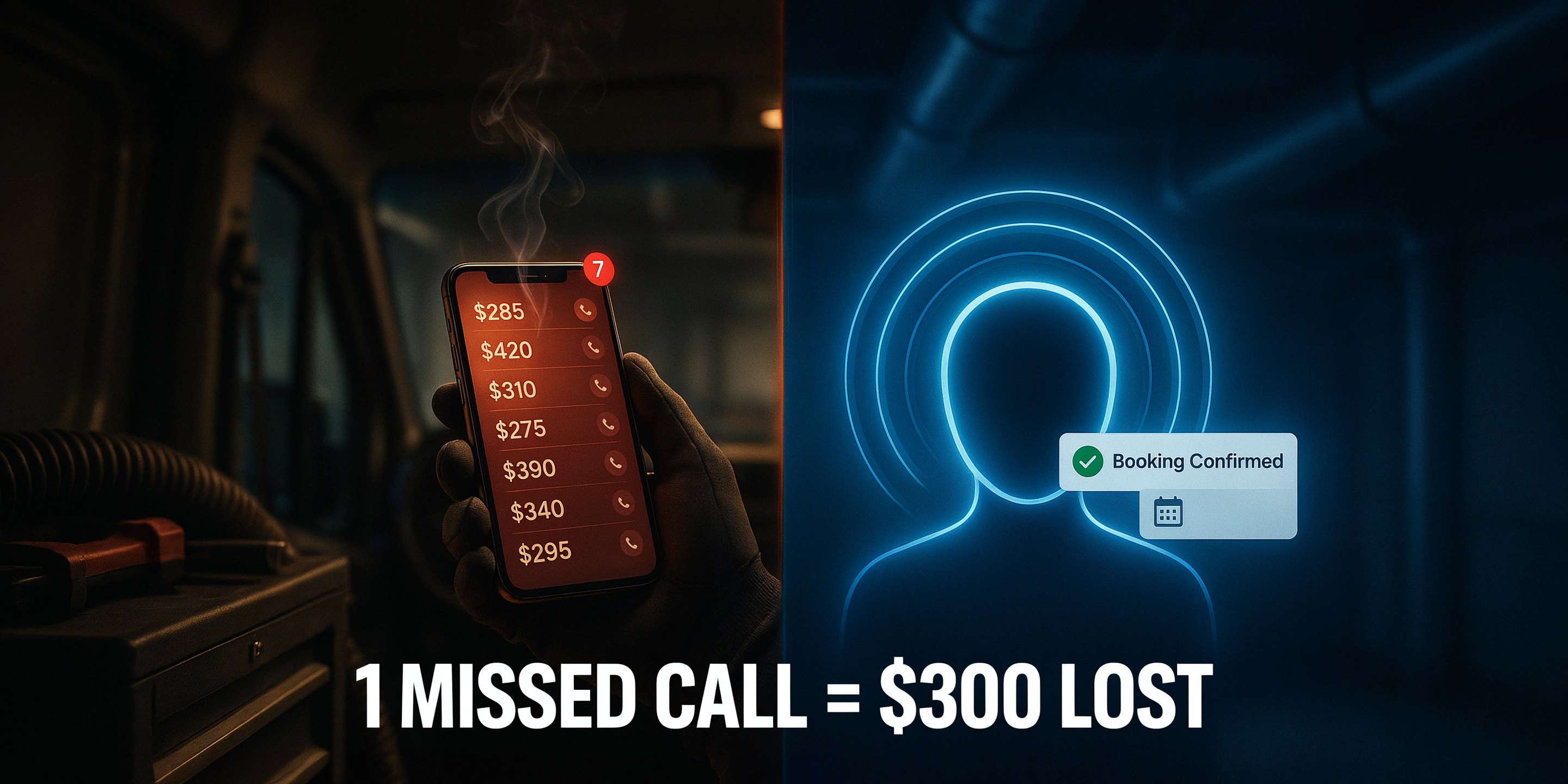
You spent money getting your phone to ring. If a technician is on a job and nobody picks up, that marketing spend just funded a call your competitor took.
This is the missed-call problem, and it's not minor for trades businesses. The instinct is to hire a receptionist or an answering service. In 2026, the math on AI voice receptionists has shifted enough that it warrants a real comparison — not the marketing pitch version, but the actual cost-and-outcome version.
Want a free audit of your own site?
Send us your website and we will review your Google, website and lead tracking, then email you what to fix first. No pitch.
Free. Read-only. We change nothing on your site.How Many Calls Are You Actually Missing?
More than you think. Home service businesses miss an average of 27% of inbound calls, according to Invoca's analysis of call tracking data across the industry. That's during normal business hours. During a July heat wave or a winter freeze — when call volume spikes and every tech is deployed — that rate climbs sharply.
There's also an after-hours problem. 35–40% of inbound calls to home services contractors come in after business hours. If you close at 5 PM and don't have coverage, you're declining nearly half your inbound calls before they ever have a chance to become jobs.
And the voicemail fallback doesn't work the way most owners assume. 85% of callers who reach voicemail never call back. They hang up and dial the next plumber on the list.
What This Costs in Real Dollars
Let's put numbers on it. Say your average HVAC service call generates $400, and your average emergency job — a failed compressor or a burst pipe on a Saturday night — runs $800–$1,200. If you're missing 15 calls a month:
- 15 missed calls × 44% average book rate = roughly 6–7 jobs you didn't get
- At $600 average: $3,600–$4,200 in missed monthly revenue
- At $1,000 average (emergency-weighted): $6,000–$7,000
Invoca's home services call data puts the average missed call value at $300–$1,200 depending on service type. Plumbers handling emergency calls sit at the high end. Routine maintenance calls sit lower.
Run this on your own call log: pull the last 30 days from your phone provider, count unanswered calls, and multiply by your average ticket. Most owners find a number they weren't expecting.
What an AI Voice Receptionist Actually Does
The modern AI voice receptionist is not the IVR phone tree from 2010. Current systems handle real conversations — they can ask what's wrong, collect the caller's address, confirm if it's an emergency, and book directly into your calendar or dispatch software. They handle Spanish-language callers. They escalate to a live person when the situation calls for it.
For HVAC and plumbing businesses, the main use cases are:
- After-hours call capture. Someone calls at 9 PM with a no-heat situation. The AI takes the call, confirms the emergency, collects contact info, and either books a morning appointment or escalates to your on-call tech.
- Peak season overflow. During a heat wave, your office line rings faster than one person can handle. AI answers simultaneously — no hold music, no voicemail.
- Appointment confirmation and rescheduling. Existing customers calling to move their appointment don't need to talk to a person; the AI handles it and updates your calendar.
The AI voice receptionist we set up for service businesses integrates with common field service platforms — ServiceTitan, Housecall Pro, Jobber — and handles call-to-calendar booking without requiring a human in the middle.
The Cost Comparison: AI vs. Answering Service vs. In-House
Here's where the math has shifted in the last 18 months:
- In-house receptionist: $1,500–$3,000 per month in salary and benefits. Business hours only. One call at a time. Source: Pipeline On's 2026 contractor AI guide.
- Live answering service: $200–$500 per month for basic call answering. No dispatch integration. The agent reading a script won't know your service area or your pricing.
- AI voice receptionist: $200–$700 per month for 24/7 coverage, multi-line handling, CRM and dispatch integration, and a consistent call experience. Source: Pipeline On.
At the high end ($700/month), an AI receptionist costs about a quarter of an in-house receptionist's monthly salary — and covers hours a human can't.
The break-even math: if you're missing 10 calls a month with a $400 average ticket and a 44% book rate, that's roughly $1,760 in monthly missed revenue. An AI voice system at $400/month pays for itself if it captures just two of those jobs.
Want a free audit of your own site?
Send us your website and we will review your Google, website and lead tracking, then email you what to fix first. No pitch.
Free. Read-only. We change nothing on your site.What to Look for in an AI Receptionist for Trades Businesses
Not all of these tools are built for field service. Generic AI receptionist products handle simple inbound calls fine but fall apart when a caller asks "do you service Scottsdale?" or "how soon can someone come out?" — questions that require knowing your service area, availability, and pricing.
Before choosing a platform, confirm:
- Does it integrate with your dispatch software? A system that captures contact info but doesn't push to your calendar creates extra work. The whole point is removing friction.
- Can it handle real-time scheduling, or just message-taking? There's a big difference between "someone will call you back" and an AI that actually books the appointment.
- Does it route emergency vs. non-emergency calls differently? A $100 drain cleaning doesn't need the same escalation response as a flooded basement at midnight.
- Can you review call recordings? This matters for quality control and for disputing mislabeled leads if you're also running LSAs.
Pairing voice AI with appointment scheduling automation is where the efficiency really compounds — the AI doesn't just capture the lead, it closes the appointment. And connecting that to automated follow-up sequences means a captured lead gets a confirmation text, a reminder, and a post-job review request without anyone touching it manually.
What AI Voice Can't Do
Be honest about the limits. AI voice handles high-volume, structured interactions well. It handles nuance poorly.
If a caller is angry and wants to speak to an owner, the AI should transfer — not try to de-escalate. If someone is describing a complex situation that requires diagnostic judgment, a human tech or dispatcher needs to take that call. If the caller can't communicate what the problem is, pushing them through an AI script makes it worse.
The right setup is AI handling first contact — capture, qualify, book — and handing off to a human when the situation calls for it. That means you still need someone available for escalations during business hours. What you eliminate is the need for 24/7 live coverage just to capture standard after-hours booking calls.
If you want to see what a missed-call audit looks like for your specific business — call volume, estimated missed revenue, and where AI coverage would have the biggest impact — that's part of what we cover in our free 24-hour audit. Book your audit here and we'll pull the numbers for your market.
Want to know what is actually broken on your site?
We audit your website, your Google Business Profile and your ad account, then send you a written report inside 24 hours. No pitch, no pressure — you get the plan whether you hire us or not. Start your free audit, see what we charge, or call (623) 343-3141 and talk to a person.
We are based in Phoenix and work with service businesses across the Valley — Mesa, Gilbert, Chandler, Tempe, Scottsdale and Phoenix.
Sources
- Invoca: How Much Missed Sales Calls Cost Home Services Businesses
- Hicira: Missed Call Statistics 2026 — 90+ Stats, Sources Linked
- Pipeline On: AI Receptionist for Contractors — 2026 Platforms, Pricing, and What Actually Books Jobs
- SkipCalls: AI Receptionist for HVAC — Stop Losing Revenue to Missed Calls During Peak Season
- HyperLeap: Why Home Service Businesses Lose Jobs to the Contractor Who Answers First
Related reading
Everything Valley Does
AI marketing agents and full website builds — all under one roof.
Serving service businesses across the Phoenix Valley
Free tools
How Valley Can Help
We Help Businesses Like Yours Get More Leads — and Close More of Them
The Valley Marketing Group is a Phoenix-based marketing agency specializing in AI-powered lead generation, paid advertising, and web development for local service businesses.
- Google Ads & paid search — campaigns built to generate qualified leads, not just clicks
- AI phone receptionist — never miss a call or lead while you're on the job
- Website design & development — WordPress, Webflow, Shopify, WooCommerce
- SEO content & local search — rank for the searches your customers are already making
Missing Calls and Leads?
We'll show you exactly how many calls and leads you're losing right now, and what an AI agent would recover for your business.
No generic report. No obligation.
Get My Free Audit