Schema Markup for Service Businesses: How to Get Cited in Google AI Overviews
July 3, 2026 · The Valley Marketing Group
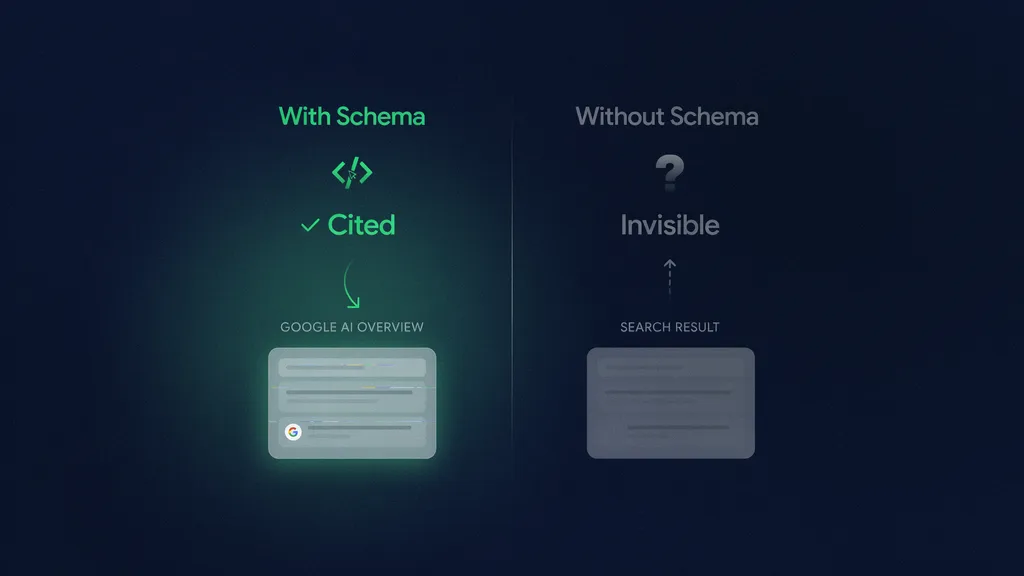
Google AI Overviews — those AI-generated summaries that now appear at the top of many search results — are the new first page. Getting cited in one is the new ranking number one. And the businesses getting cited consistently have one thing in common: complete schema markup.
If you run an HVAC company, a dental practice, a law firm, or any other service business, your website probably either has no schema markup or has a partial implementation that tells Google's AI almost nothing useful. That is fixable. The payoff is significant. Here is what the data shows and exactly what to implement.
Why Schema Markup Suddenly Matters More
Google's AI Overviews do not read websites the way humans do. They pull structured facts — your service types, your location, your hours, your reviews — and synthesize an answer to a search query. If your website gives the AI a machine-readable fact sheet, it can include you confidently. If it cannot easily extract your core information, it finds another business that makes it easier.
According to Atlas Unchained's AI citation analysis, businesses with proper schema markup are cited in Google AI Overviews 3.2 times more often than businesses without it. Stackmatix's structured data research puts the figure at 2.5 times more likely to appear in AI-generated answers.
The exact multiplier varies by source and query type. The directional finding does not: schema markup is the clearest technical signal you can send that meaningfully improves AI Overview inclusion for local service businesses.
The 4 Schema Types That Get Service Businesses Cited
You do not need to implement every possible schema type. For a local service business, four types drive the majority of the results, according to OAT Marketing's AI Overviews guide for local businesses:
- LocalBusiness schema: the foundation — who you are, where you operate, and how to reach you
- Service schema: what specific services you offer, with descriptions
- FAQPage schema: your common customer questions marked up so AI can extract specific answers
- Review / AggregateRating schema: your star rating and review count as structured data
Implement all four. Starting with just LocalBusiness and skipping the others is leaving the majority of the benefit on the table.
LocalBusiness Schema: The Foundation
LocalBusiness schema is the first thing to implement and the most important to get exactly right. The critical rule: your schema must match your Google Business Profile exactly. Same legal name. Same street address format. Same phone number format. Same hours of operation.
A mismatch between your schema and your Google Business Profile creates conflicting signals that make AI systems uncertain about your data — and uncertain data gets excluded. Google's official LocalBusiness structured data documentation specifies required and recommended fields in detail.
Core fields your LocalBusiness schema must include:
- @type: Your specific business type (HVACBusiness, Dentist, LegalService, Plumber, GeneralContractor, etc.)
- name: Your exact legal business name
- address: Full PostalAddress with street, city, state, and zip
- telephone: Your main phone number
- openingHoursSpecification: Your hours for each day you are open
- areaServed: The cities and zip codes you serve
- url: Your website URL
- priceRange: Even a simple two-dollar-sign indicator helps the AI characterize your business
Service Schema: Tell Google What You Actually Do
Most service businesses have a services page, but without Service schema it is just unstructured text. Service schema makes each offering machine-readable — so when someone asks Google AI who does AC replacement in Phoenix, the AI can match your Service schema entry for that service with the location data from your LocalBusiness schema and cite you with confidence.
For each major service you offer, add a Service schema block with:
- @type: "Service"
- name: The service name — use the terms your customers actually search, not internal jargon
- description: A one to two sentence description of what the service includes
- provider: A reference back to your LocalBusiness schema
- areaServed: The geographic area where you offer this service
Cover your 5–8 primary revenue-generating services with Service schema. That gives the AI enough to work with. Do not try to list every sub-service variation — it creates noise without adding meaningful signal.
Want more like this?
Get our monthly newsletter — real marketing tips for service businesses. No fluff, unsubscribe anytime.
Ready to talk now? Get a free 24-hour audit instead →FAQ Schema: The Fastest Path to AI Overview Inclusion
FAQPage schema is the quickest route to being cited for a specific customer question. When someone asks Google "how much does it cost to replace an AC unit in Phoenix," the AI looks for web pages with an FAQ entry that directly answers that question, marked up as FAQPage schema.
Add an FAQ section to each of your main service pages and service area pages — not just your homepage. Each FAQ entry should:
- Use plain language questions that match how real customers ask, not keyword-stuffed phrases
- Give a genuine, complete answer in two to four sentences — not a teaser that requires clicking through to get the answer
- Be marked up with the FAQPage type containing Question and Answer structured data entities
A good starting point is four to six FAQ entries per service page, covering the questions you get most often on sales calls. Cost, timeline, what is included, warranty terms, and licensing questions are the highest-value ones to answer in schema form. Our SEO content AI agent can generate and implement FAQ schema for your service pages automatically if you have multiple pages to update at once.
Review Schema: The Trust Signal AI Cannot Ignore
Google's AI Overviews give significant weight to businesses with credible review signals. An AggregateRating block inside your LocalBusiness schema gives the AI a quantified trust indicator — your total review count and average star rating — that it can reference when deciding which businesses to cite and how confidently to recommend them.
The AggregateRating block goes inside your LocalBusiness schema:
- ratingValue: Your current average rating, such as 4.8
- reviewCount: Your total number of reviews across the platform
- bestRating: 5
- worstRating: 1
Keep this block current. If your schema says you have 47 reviews at 4.8 stars but you actually have 230 reviews at 4.9 stars, the outdated schema underrepresents your credibility. Update it quarterly at minimum — more often if your review volume is high. For the broader local SEO context around AI Overviews, see our post on what Google AI Overviews mean for service businesses and our guide to near-me SEO for service businesses.
Implementation: JSON-LD Goes in Your Page Head
Google recommends JSON-LD for schema markup — it is cleaner, easier to maintain, and does not require modifying your visible page content. JSON-LD goes in a script block with type "application/ld+json" in your page head section.
Implementation checklist:
- Add your LocalBusiness JSON-LD block to every page on the site (put it in your site-wide head template, not just the homepage)
- Add Service schema to each individual service page
- Add FAQPage schema to your service pages and location landing pages
- Add the AggregateRating block inside LocalBusiness on the homepage and any review-focused pages
- Validate every page using Google's Rich Results Test after implementation
- Submit updated URLs in Google Search Console to speed up indexing of your schema changes
Schema markup is not a one-time setup. It is an asset you maintain alongside your Google Business Profile and your review count. A business that treats its schema the way it treats its GBP — updated, accurate, and complete — is the business Google's AI cites with confidence.
If you want a concrete list of what to implement first on your specific site, our team offers a free 24-hour audit that covers schema alongside your broader local SEO and Google Ads picture.
Want to know what is actually broken on your site?
We audit your website, your Google Business Profile and your ad account, then send you a written report inside 24 hours. No pitch, no pressure — you get the plan whether you hire us or not. Start your free audit, see what we charge, or call (623) 343-3141 and talk to a person.
We are based in Phoenix and work with service businesses across the Valley — Mesa, Gilbert, Chandler, Tempe, Scottsdale and Phoenix.
Sources
- Atlas Unchained — Schema Markup AI Citation Playbook
- Stackmatix — Structured Data for AI Search 2026
- OAT Marketing — How Local Businesses Can Show Up on Google AI Overviews
- Google Search Central — LocalBusiness Structured Data Documentation
- Discoverability — Schema Markup Guide for SEO and AI Search 2026
Everything Valley Does
AI marketing agents and full website builds — all under one roof.
Serving service businesses across the Phoenix Valley
Free tools
How Valley Can Help
We Help Businesses Like Yours Get More Leads — and Close More of Them
The Valley Marketing Group is a Phoenix-based marketing agency specializing in AI-powered lead generation, paid advertising, and web development for local service businesses.
- Google Ads & paid search — campaigns built to generate qualified leads, not just clicks
- AI phone receptionist — never miss a call or lead while you're on the job
- Website design & development — WordPress, Webflow, Shopify, WooCommerce
- SEO content & local search — rank for the searches your customers are already making
Not Showing Up in Local Search?
We'll check your Google Business Profile, local rankings, and citations — and show you exactly what's holding you back from the map pack.
No generic report. No obligation.
Check My Local SEO