Landscaping Company Google Ads: What Leads Cost in 2026
June 19, 2026 · The Valley Marketing Group
If you run a landscaping or lawn care business and you've been curious whether Google Ads actually works for your trade — or you're already running campaigns and wondering why the results feel inconsistent — the numbers below will give you a straight answer.
Landscaping Google Ads work. They also have some specific quirks that make them different from HVAC or plumbing campaigns, and those quirks cost money if you don't plan for them. The biggest one: not all landscaping services produce the same lead cost, and the difference isn't small. Here's what the data says and how to use it.
Want a free audit of your own site?
Send us your website and we will review your Google, website and lead tracking, then email you what to fix first. No pitch.
Free. Read-only. We change nothing on your site.The Benchmark Numbers
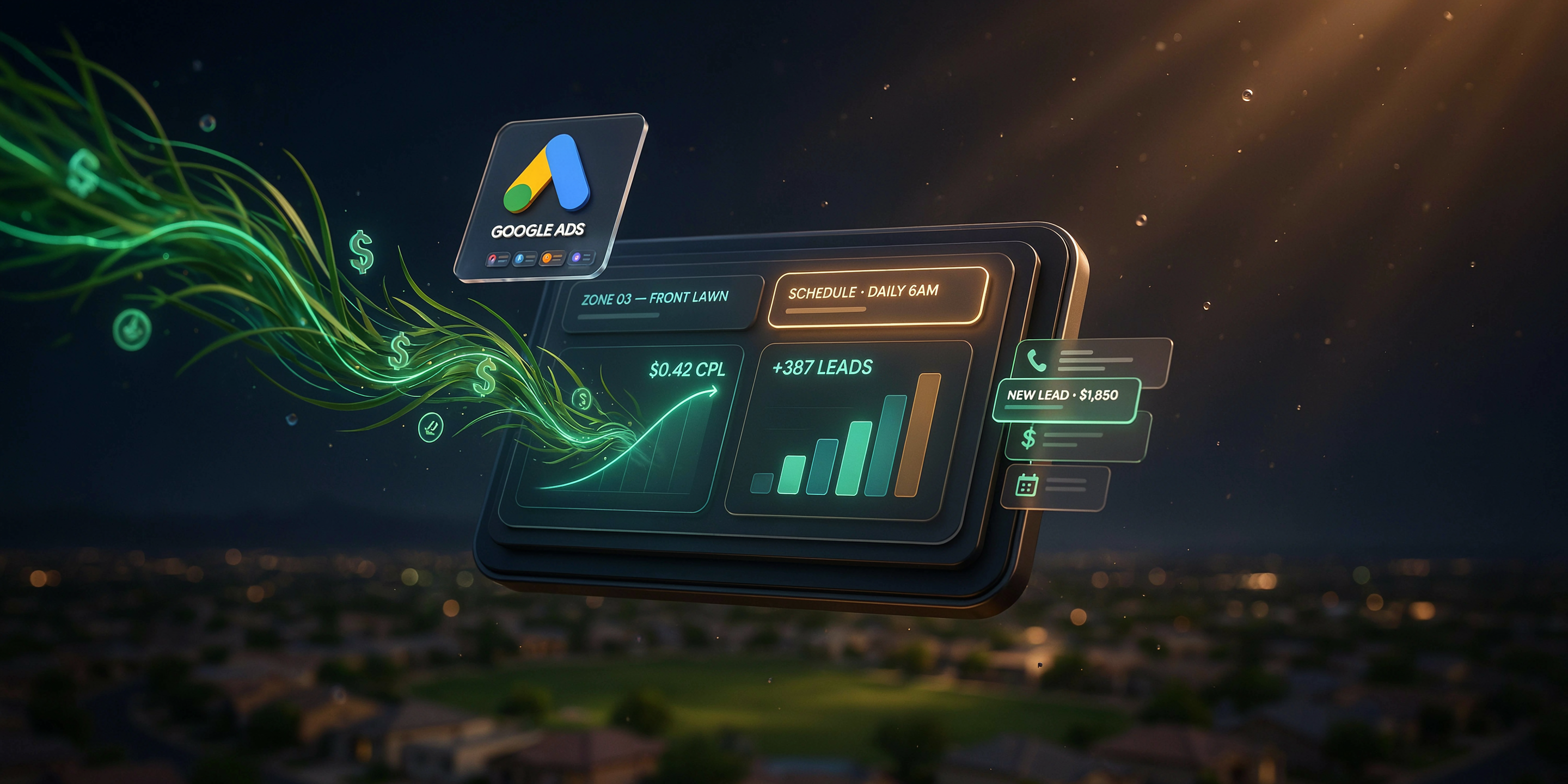
According to benchmark data published by Evergrow Marketing, which analyzed 61 landscaping companies spending $225,000 in aggregate Google Ads spend, the average cost per click for landscaping ads is $3.65 and the average cost per lead is $87.80. That's from 2024 data — by 2026, increased competition in most metros has nudged that number up slightly.
Green Industry Pros puts a good 2026 CPL target for landscaping at $94–$125, with well-optimized campaigns hitting 5–8% conversion rates on high-intent keywords. That gives you the math: to generate 10 leads per month, you're spending roughly $940–$1,250 at target CPL, or more if your landing page or targeting isn't dialed in.
For comparison: a plumbing lead on Google LSA runs $57, an HVAC lead runs $51. Landscaping sits higher partly because the CPC is more competitive in spring and partly because landscaping searches are broader — you're competing against design ideas sites, YouTube videos, and Angi profiles, not just other contractors.
Why Service Type Changes Everything
The single biggest mistake landscaping companies make with Google Ads is treating all their services as one campaign. A lawn maintenance lead and a hardscaping lead are completely different customers with completely different economics.
Here's what the service-type split looks like:
- Recurring lawn care / maintenance: CPL runs higher relative to ticket value because the initial job is small ($50–$200/visit) and the customer decision is quick. You're competing on availability and price. The real value is lifetime customer value, not the first ticket — but that's harder to track in Ads.
- Landscaping design and installation: CPL can be higher in dollar terms ($100–$150+) but the average project ticket is $3,000–$15,000+. That math works much better even at elevated CPL.
- Hardscaping (patios, retaining walls, driveways): High ticket, high intent, and worth paying more per lead. These buyers are further in the decision process and searching specifically for what they want.
- Irrigation / sprinkler installation: Seasonal, specific, and high value. Runs well as its own campaign with dedicated keywords.
According to Leads4Build, the CPL gap between service types can be $50–$150 within the same account. If you're blending lawn care and hardscaping into one campaign, you're getting a misleading average that tells you nothing useful about either service.
Search Ads vs. Google LSA for Landscapers
Google Local Services Ads are available for landscaping in most markets and deliver leads with the Google Verified badge — the same trust signal that used to be called Google Guaranteed. For recurring lawn care services where trust and speed matter most, LSA leads often convert at a higher rate per dollar because the searcher is already primed to call.
The tradeoff: LSA gives you less control over the type of job that comes in. You can set your service categories and area, but you can't control which specific service someone calls about the way you can with search keywords. For a company that wants to specialize in high-ticket design-build work, search campaigns with tightly controlled keywords will produce better-fit leads.
The practical answer for most landscaping companies: run both. Use LSA for lawn care, cleanups, and maintenance leads. Use search campaigns for high-ticket installation and design projects where you can control the keywords and match them to a specific landing page. Our Google Ads management service builds this kind of layered structure specifically for home service businesses that have both recurring and project-based revenue.
The Seasonality Problem
This is where most landscaping ad accounts bleed money. Spring CPCs spike because every landscaper in your market is suddenly running ads at the same time. If you turned your campaigns off in November and back on in March, you're paying premium CPCs with a cold account history — Google hasn't learned your audience yet, so your Quality Scores start low and your costs run high.
The fix is to stay on year-round at a reduced budget. Run $300–$500/month in winter to maintain account health and capture any off-season project leads (patios and hardscaping don't wait for spring). When March hits, your account has history, your Quality Scores are solid, and your CPCs are lower than the competitor who just turned theirs back on.
A keyword like "landscaping company Phoenix" costs meaningfully more in April than in January — in some markets, two to three times more. Running year-round costs less over 12 months than running at high budgets only in spring in many scenarios, and it produces more consistent lead flow.
What a Realistic Budget Looks Like
Based on current benchmarks and the CPL data above, here's how to think about budgets:
- Testing phase ($750–$1,000/month): Enough to gather data on a single service type in a single geography. Don't make major decisions for at least 90 days.
- Growth phase ($1,500–$3,000/month): Running multiple service campaigns, beginning to optimize based on actual cost-per-booked-job data.
- Scaling phase ($3,000+/month): Running LSA plus search, segmented by service, with call tracking that connects leads to actual revenue.
The rule that applies across all stages: if you're not tracking which leads turn into paying jobs, you don't have a real budget — you have a guess. Call tracking that ties each Google Ads click to a specific phone call, then to a booked appointment, is the difference between knowing your ROI and hoping your ROI is positive.
Want a free audit of your own site?
Send us your website and we will review your Google, website and lead tracking, then email you what to fix first. No pitch.
Free. Read-only. We change nothing on your site.The Keywords That Work (and the Ones That Don't)
High-intent keywords that consistently convert for landscaping businesses:
- "landscaper near me"
- "lawn care [city]"
- "landscaping company [city]"
- "lawn mowing service [city]"
- "sprinkler installation [city]"
- "patio installation [city]"
- "retaining wall contractor [city]"
Keywords to exclude (add as negatives):
- "landscaping ideas"
- "DIY landscaping"
- "landscaping plants"
- "landscaping salary" / "landscaping jobs"
- "landscaping school"
If you're not running a long, specific negative keyword list, you're paying for clicks from people looking for landscaping careers or Pinterest inspiration. The automated optimization we run on client accounts adds negatives on a rolling basis as search term reports come in — typically saving 15–25% of monthly spend within the first 60 days.
The Landing Page Problem
Most landscaping company websites weren't built to convert Google Ads traffic. A homepage with a slider, a list of services, and a contact form in the footer is not a landing page. When someone clicks your ad for "patio installation Phoenix," they should land on a page that talks exclusively about patio installation in Phoenix — with photos of real jobs, a clear phone number above the fold, and a simple form that asks only what they need to get a quote.
Matching your ad to a specific landing page typically improves conversion rate by 30–50% compared to sending all traffic to your homepage. That means your CPL drops without touching your bids. It's the fastest lever available in most landscaping accounts we look at. The SEO content service we build for service businesses includes landing pages designed specifically for paid traffic, not just organic search.
Bottom Line
Google Ads works for landscaping businesses. The CPL is manageable at $87–$125 for well-run campaigns, and the ticket values — especially for design and hardscaping work — make the math work comfortably. The traps are seasonal thinking, blended service campaigns, and sending traffic to a homepage instead of a dedicated landing page.
Fix those three things and landscaping Google Ads look very different from the results most companies report when they say "we tried ads and it didn't work."
If you want an honest look at what your specific market and service mix would cost to run on Google Ads, book a free 24-hour audit. We'll pull competitor spend data for your area and tell you exactly what it would take to compete — and whether the ROI math works for your tickets.
Want to know what is actually broken on your site?
We audit your website, your Google Business Profile and your ad account, then send you a written report inside 24 hours. No pitch, no pressure — you get the plan whether you hire us or not. Start your free audit, see what we charge, or call (623) 343-3141 and talk to a person.
We are based in Phoenix and work with service businesses across the Valley — Mesa, Gilbert, Chandler, Tempe, Scottsdale and Phoenix.
Sources
- Evergrow Marketing – 2025 Landscaping and Lawn Care Google Ads Benchmarks
- Green Industry Pros – Google Ads Benchmarks for Landscaping and Lawn Care
- Leads4Build – Google Ads for Landscapers: Budget and Structure That Works
- Built Right Digital – Landscaping Google Ads Cost: How Much Contractors Should Spend
Related reading
Everything Valley Does
AI marketing agents and full website builds — all under one roof.
Serving service businesses across the Phoenix Valley
Free tools
How Valley Can Help
We Help Businesses Like Yours Get More Leads — and Close More of Them
The Valley Marketing Group is a Phoenix-based marketing agency specializing in AI-powered lead generation, paid advertising, and web development for local service businesses.
- Google Ads & paid search — campaigns built to generate qualified leads, not just clicks
- AI phone receptionist — never miss a call or lead while you're on the job
- Website design & development — WordPress, Webflow, Shopify, WooCommerce
- SEO content & local search — rank for the searches your customers are already making
Google Ads Causing Trouble?
We'll look at your Google Ads account for free and show you where budget is being wasted, what needs fixing, and where the best opportunities are.
No generic report. No obligation.
Get My Free Audit