Google LSA Cost Per Lead for HVAC and Plumbing in 2026: Is It Worth It?
June 21, 2026 · The Valley Marketing Group
Google Local Service Ads are now running HVAC contractors an average of $51–$63 per lead in 2026, and plumbers between $57 and $69. Whether that's a bargain or a money pit depends on one number most contractors never track.
LSAs have become the primary paid channel for service businesses across the country. Adoption jumped from roughly 28% of contractors using them in 2022 to an estimated 70% by late 2025. If you're not running them, most of your competitors are. But running them without understanding the real cost structure means you're spending blind.
Want a free audit of your own site?
Send us your website and we will review your Google, website and lead tracking, then email you what to fix first. No pitch.
Free. Read-only. We change nothing on your site.What Google LSAs Actually Cost in 2026
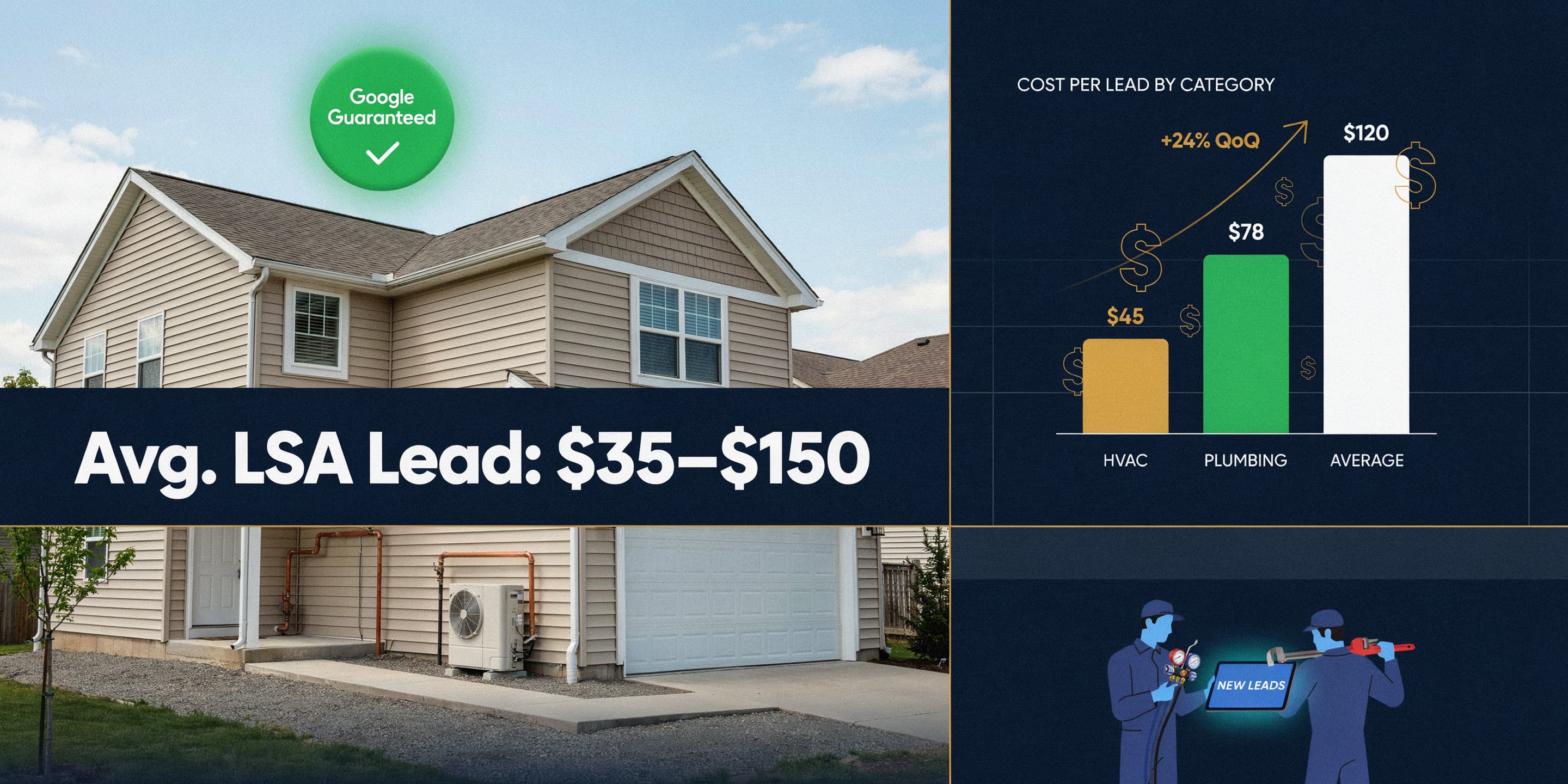
Let's start with the numbers. The blended national average cost per lead across all trades is $53, but the range by trade and market is wide:
- HVAC: $51 per lead in February 2026, climbing to approximately $63 in May as cooling season demand builds
- Plumbing: $57 in February, up to $69 in May
- Electrical: Typically $40–$60
- Roofing: Often $80–$120 in competitive markets
These are national averages. A $53 national average can mask $30 CPLs in smaller markets and $90-plus in competitive metros like Phoenix, Dallas, and Los Angeles. If you're in the East Valley competing against 25 HVAC companies, your actual cost per lead is higher than any benchmark article will tell you.
Unlike traditional Google Ads, you pay per lead — not per click. You're charged for qualified leads only: calls that meet a minimum duration, or messages that come through the LSA platform. Google also has a dispute process for calls that were clearly wrong service category, spam, or outside your area.
The Number That Matters More Than CPL: Your Book Rate
Cost per lead is what everyone talks about. Book rate determines whether you make money.
The average book rate across all LSA leads is 43.9%. For every 10 calls you get from LSAs, roughly 4 convert to booked jobs. That's actually high for paid traffic — LSAs capture high-intent searchers. Someone typing "emergency plumber" at 9 PM on a Tuesday is not browsing. They're buying.
Here's why this matters in practice: if you're an HVAC company paying $63 per lead with a 44% book rate, you're paying roughly $143 per booked job. If your average service call generates $350, that's a 2.4x return before parts and labor. If your average job is a $4,000 AC replacement, the math is much better.
Run this formula on your own numbers: (average CPL) ÷ (book rate) = cost per booked job. Compare that to your average job revenue. Under 30% of job revenue — you're profitable. Above 50% — something needs to change, either your conversion rate or your bid strategy.
Why LSA Costs Swing So Much
Three things drive your actual cost per lead:
- Market density. More HVAC companies bidding on the same Phoenix zip code means higher costs. Smaller markets have less competition and lower CPLs.
- Seasonality. HVAC costs spike May–June and December–January. Plumbing spikes during cold snaps when pipes freeze. Plan your budget around these cycles instead of spreading spend evenly across 12 months.
- Your profile quality. Google's LSA algorithm considers your review score, review count, responsiveness, and profile completeness. According to Google's own documentation, businesses with more reviews and faster response times rank higher — and a higher rank generally means lower effective CPL because you capture more leads at the same budget.
One Feature Most Contractors Skip: Message Leads
Here's a lever most HVAC and plumbing companies ignore. Accounts with message leads enabled generate 43% more leads on average and see a 19% increase in impressions compared to call-only accounts.
If your LSA account only takes phone calls, you're missing a large segment of customers — particularly for non-emergency services — who prefer to text first before committing to a call. Enabling messages costs nothing extra and has a measurable impact on lead volume and profile visibility.
The catch: you have to respond to messages fast. Slow response sends a negative signal to Google's ranking algorithm. If your front office can't monitor messages during business hours, automating your lead response with a system that acknowledges and qualifies messages instantly will protect both lead quality and your LSA ranking.
When LSAs Don't Make Sense
Not every service business should be running LSAs. The math breaks down when:
- Your average job value is low. A landscaping company with $200 average tickets can't absorb a $60–$80 CPL profitably. LSAs work best for businesses where average jobs run $400 or more.
- You have a response time problem. If calls go to voicemail during business hours, or you're taking 4–6 hours to respond to message leads, Google will penalize your ranking — you'll pay more per lead while getting fewer of them. Fix your answer rate first.
- You haven't verified your Google Guarantee. The green checkmark is what makes LSAs visually dominant in search results. Without completing the background check and license verification, you're paying for a reduced ad unit.
- Your review count is below 10. A bare profile with 6 reviews and a 4.3-star average will consistently rank below a competitor with 80 reviews and a 4.7 average, even if you bid higher. Build your review base before spending heavily on LSAs.
Want a free audit of your own site?
Send us your website and we will review your Google, website and lead tracking, then email you what to fix first. No pitch.
Free. Read-only. We change nothing on your site.How to Lower Your Cost Per Lead
If you're running LSAs and the CPL feels high, there are real levers:
- Dispute bad leads. A lead from the wrong city, a call under 30 seconds that was clearly a wrong number, a lead for a service you don't offer — dispute these. You won't win every one, but the credits add up over a year.
- Tighten your service area. If you're covering 40 zip codes but 90% of revenue comes from 15, narrow your LSA coverage. Less geographic spread means more relevance in your actual market and lower costs.
- Keep review velocity high. Every month without new reviews, your profile looks more dormant. A structured post-job review request sequence is the cheapest way to improve your LSA ranking.
- Set bid caps by season. Don't pay May prices in November. Adjust your maximum bid down during slow season when competition drops and you can still rank at a lower rate.
LSAs vs. Traditional Google Search Ads: Which Wins for HVAC and Plumbing?
This comes up constantly. The short answer: run both if your budget allows, and prioritize LSAs if you can only do one.
Traditional Google Search Ads give you more control — you set keywords, write ad copy, and control landing pages. But you're paying per click, not per lead, and you need someone who knows what they're doing to manage match types, negative keywords, and Quality Scores. Done wrong, Google Ads is an expensive education.
LSAs are simpler, lead-based, and carry the Google Guarantee — a meaningful trust signal traditional ads don't have. Businesses that appear in LSA results get 25–30% more calls than those relying on organic listings alone.
If your budget is $1,500 per month or less, start with LSAs. If you can go higher, layer in managed Google Ads for service-specific keywords where LSAs don't show.
Want to know if your current Google spend is producing the right return, or if there's a better setup for your trade and market? We run free 24-hour audits — no sales pitch, just the data. Book yours here.
Want to know what is actually broken on your site?
We audit your website, your Google Business Profile and your ad account, then send you a written report inside 24 hours. No pitch, no pressure — you get the plan whether you hire us or not. Start your free audit, see what we charge, or call (623) 343-3141 and talk to a person.
We are based in Phoenix and work with service businesses across the Valley — Mesa, Gilbert, Chandler, Tempe, Scottsdale and Phoenix.
Sources
- Searchlight Digital: Google LSA Cost Per Lead by Trade (2026)
- Blue Grid Media: How Much Does Google LSA Cost in 2026? Real CPL Data by Industry
- The Media Captain: Local Service Ads Stats and Cost Per Lead Data
- Elevation10k: Google Marketing Live 2026 — Home Services Takeaways
- Google: About Ad Rankings — Local Services Help
- Steady Demand: LSA Performance Insights — March 2026 Update
Related reading
Everything Valley Does
AI marketing agents and full website builds — all under one roof.
Serving service businesses across the Phoenix Valley
Free tools
How Valley Can Help
We Help Businesses Like Yours Get More Leads — and Close More of Them
The Valley Marketing Group is a Phoenix-based marketing agency specializing in AI-powered lead generation, paid advertising, and web development for local service businesses.
- Google Ads & paid search — campaigns built to generate qualified leads, not just clicks
- AI phone receptionist — never miss a call or lead while you're on the job
- Website design & development — WordPress, Webflow, Shopify, WooCommerce
- SEO content & local search — rank for the searches your customers are already making
Google Ads Causing Trouble?
We'll look at your Google Ads account for free and show you where budget is being wasted, what needs fixing, and where the best opportunities are.
No generic report. No obligation.
Get My Free Audit