Your Google Ads Are Losing Half Their Value — Your Landing Page Is Why
June 17, 2026 · The Valley Marketing Group
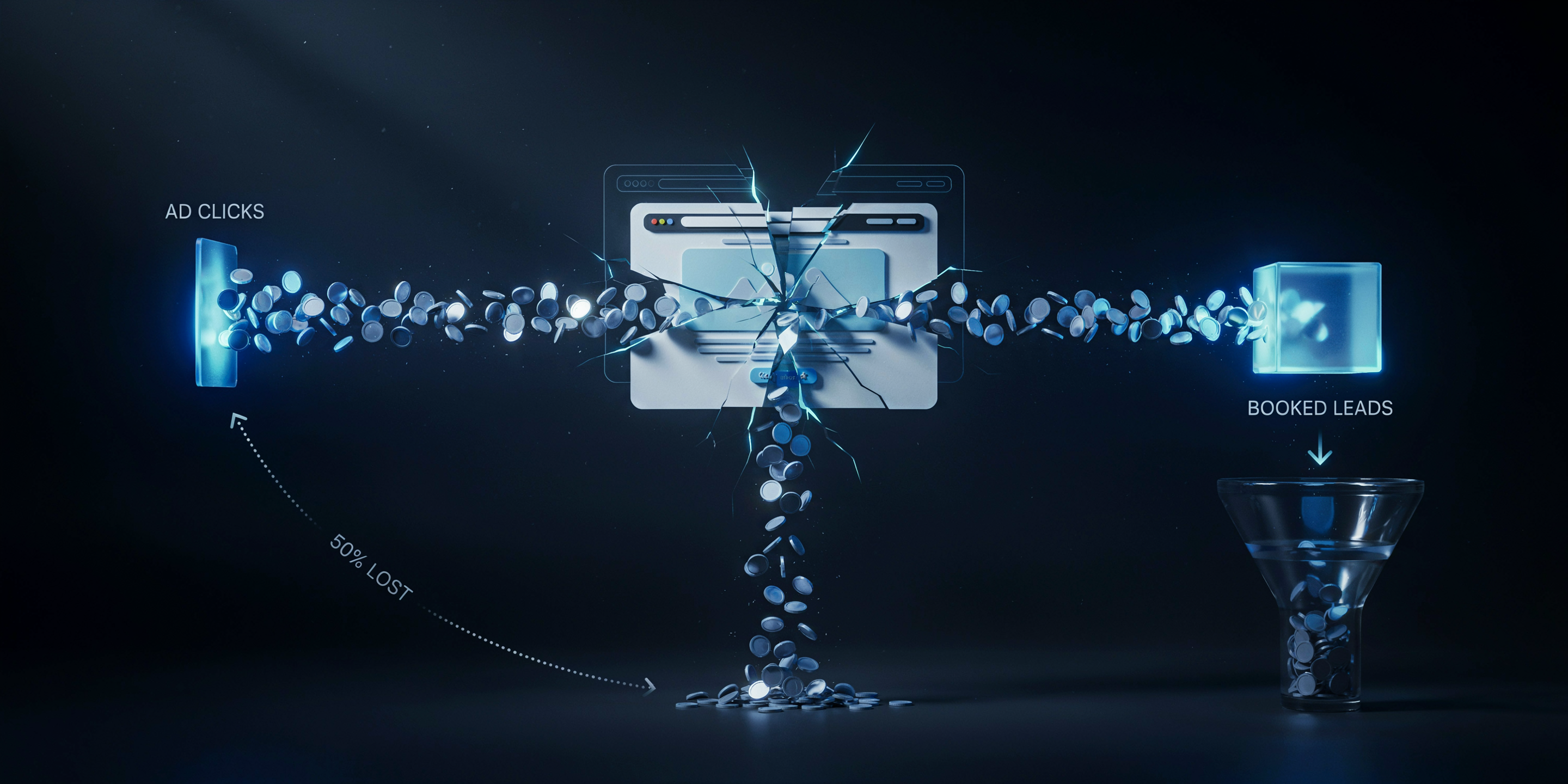
You can spend $3,000 a month on Google Ads and lose half of that budget because the page your ad sends people to is your homepage. This is the most common and most expensive mistake service business owners make with paid search.
Getting clicks from Google Ads isn't the hard part. Converting those clicks into phone calls is. The single biggest variable between a Google Ads campaign that books jobs and one that burns money is the landing page — the specific page a searcher lands on when they click your ad. Most service businesses get this completely wrong, and the cost shows up in their monthly ad bill without them knowing why.
Want a free audit of your own site?
Send us your website and we will review your Google, website and lead tracking, then email you what to fix first. No pitch.
Free. Read-only. We change nothing on your site.The Homepage Problem
When you send Google Ads traffic to your homepage, you're asking someone who just searched "emergency HVAC repair Phoenix" to arrive at a page that says something like "Welcome to Smith's HVAC. We do heating, cooling, ductwork, commercial, and residential service in the Phoenix area." That page answers a different question than the one they asked.
Industry analysis from Pipeline On and Hook Agency consistently shows that sending paid traffic to a homepage or generic services page reduces conversion rates by 30–50% versus sending the same traffic to a dedicated landing page that matches the ad's message. That's $1,500 out of every $3,000 monthly budget essentially wasted.
What "Message Match" Means and Why It Matters
Message match is the alignment between what your ad says, what the searcher typed, and what your landing page says. When these three things line up, the visitor feels like they ended up in exactly the right place. When they don't, the visitor bounces.
If your ad headline is "Same-Day AC Repair in Phoenix — Licensed & Insured," your landing page needs to immediately reinforce those exact claims: same-day service, AC repair specifically, Phoenix area, and your license and insurance status. A page that leads with "Phoenix's Trusted HVAC Company Since 2003" doesn't match — the visitor has to work to figure out if you can help them today.
Poor message match increases your bounce rate, which increases your Google Ads Quality Score cost, which increases your cost per click. It's a compounding penalty that punishes every campaign that doesn't get this right.
The Five Elements Every Service Business Landing Page Needs
A high-converting service business landing page isn't complicated, but it needs to get five specific things right:
- A headline that matches the search intent. If they searched "plumber near me," the page opens with "Licensed Plumbers in Phoenix — Available Today." Not "Welcome to Rodriguez Plumbing."
- Your phone number, large and prominent, above the fold. Most service searches happen on a phone. The visitor should be able to tap your number without scrolling. Make it a click-to-call link. Every extra step between someone deciding to call and actually calling costs you a percentage of those callers.
- Trust signals specific to your trade. Your license number. Your insurance carrier. How long you've been in business. BBB rating. These signals answer the question "is this person coming into my house going to be legitimate?" before the visitor has to ask it.
- Social proof in the right format. Two or three short, specific testimonials near the top. "Had a burst pipe at midnight — they were here within the hour. Fair price, no upselling." Specific beats generic every time.
- A short, low-friction form alongside the phone number. Some people don't want to call — they want to submit a form at 11pm and get a callback in the morning. Give them the option. Ask for name, phone, and the service they need. Three fields maximum.
One Ad Campaign, One Landing Page
One of the most common structural mistakes is running multiple ad groups targeting different services — AC repair, furnace installation, duct cleaning — but sending all of them to the same landing page. That's the same message match problem applied at scale.
The correct structure: each service has its own ad group, with ads that mention that specific service, pointing to a landing page that's built specifically for that service. Your AC repair page talks only about AC repair. Your furnace installation page talks only about furnace installation. This structure also improves your Quality Score for each campaign, which lowers your cost per click across the board.
Mobile Optimization Is Not Optional
A significant share of HVAC, plumbing, and home service searches happen on mobile devices — often from people who are already dealing with the problem right now. If your landing page loads slowly or requires pinch-and-zoom to read, those people are gone.
Your landing page should:
- Load in under 3 seconds on a mobile connection. Test it at PageSpeed Insights.
- Have the phone number in tap-friendly size, not buried in small text.
- Have form fields large enough to tap without zooming.
- Work correctly without horizontal scrolling.
Page speed is also a direct Google Ads Quality Score factor — slow pages cost more per click on top of converting worse.
Call-Only Campaigns vs. Landing Page Campaigns
For some service businesses — especially those running emergency-focused campaigns — the landing page question gets simplified by using call-only ads, which connect the clicker directly to your phone number without any intermediate page. There's no landing page to optimize because there's no landing page at all.
Call-only campaigns make sense when:
- Your business is phone-driven (emergency HVAC, emergency plumbing, locksmith)
- You want to eliminate all friction between searcher and phone call
- You're running on mobile-heavy demographics where click-to-call outperforms form submissions
The tradeoff: call-only ads generate no form leads. If a searcher is on their computer at work looking for a contractor to start a job next week, they may prefer to fill out a form and get a callback. Mixing call-only with landing page campaigns — or using a smart campaign structure — captures both types of intent.
Want a free audit of your own site?
Send us your website and we will review your Google, website and lead tracking, then email you what to fix first. No pitch.
Free. Read-only. We change nothing on your site.The Quality Score Connection
Your Google Ads Quality Score — the 1–10 rating Google assigns to each keyword — directly affects what you pay per click. A better Quality Score means lower cost per click for the same ad position. The three components of Quality Score are: expected click-through rate, ad relevance, and landing page experience.
Landing page experience is evaluated by how relevant and useful your page is to people who click the ad. Google measures bounce rate, time on page, and whether the page content matches the ad's keyword theme. A landing page that's built to match a specific campaign — with relevant content, fast load time, and a clear call to action — earns better Quality Scores, which means you're paying less per click than competitors with poorly matched pages.
Testing and the One Metric That Matters
Once you have a dedicated landing page running, the one metric to optimize is conversion rate: what percentage of visitors call or fill out a form. Don't obsess over click-through rate, impressions, or bounce rate in isolation. Track calls and form submissions per 100 visitors, and test changes against that number.
Simple things worth testing: headline variants, photo vs. no photo above the fold, phone number position, form length, and button copy ("Get a Free Quote" vs. "Book a Same-Day Visit"). Test one element at a time and give each test at least two weeks of data before drawing conclusions.
The Shortcut Most Contractors Skip
Building a proper landing page for each ad group sounds like a lot of work. It is, the first time. But every month you're running traffic to your homepage is a month you're paying for clicks that don't convert at the rate they should. The setup cost of a proper landing page is almost always recovered within 30–60 days of improved conversion rates.
If you want an audit of your current Google Ads setup — including whether your landing pages are hurting your conversion rates and what to change — book a free 24-hour audit. We'll pull the data from your account and show you exactly where the money is leaking.
Want to know what is actually broken on your site?
We audit your website, your Google Business Profile and your ad account, then send you a written report inside 24 hours. No pitch, no pressure — you get the plan whether you hire us or not. Start your free audit, see what we charge, or call (623) 343-3141 and talk to a person.
We are based in Phoenix and work with service businesses across the Valley — Mesa, Gilbert, Chandler, Tempe, Scottsdale and Phoenix.
Need the site itself rebuilt, not just the marketing fixed? We build on WordPress, Shopify, Webflow and WooCommerce — see what we build.
Sources
- Pipeline On — HVAC Google Ads: The Complete Guide to Running Profitable Campaigns
- Hook Agency — Google Ads Cost for Contractors: Pricing and ROI Guide
- Schulze Creative — 2026 Google Ads Statistics for HVAC Businesses
Related reading
Everything Valley Does
AI marketing agents and full website builds — all under one roof.
Serving service businesses across the Phoenix Valley
Free tools
How Valley Can Help
We Help Businesses Like Yours Get More Leads — and Close More of Them
The Valley Marketing Group is a Phoenix-based marketing agency specializing in AI-powered lead generation, paid advertising, and web development for local service businesses.
- Google Ads & paid search — campaigns built to generate qualified leads, not just clicks
- AI phone receptionist — never miss a call or lead while you're on the job
- Website design & development — WordPress, Webflow, Shopify, WooCommerce
- SEO content & local search — rank for the searches your customers are already making
Google Ads Causing Trouble?
We'll look at your Google Ads account for free and show you where budget is being wasted, what needs fixing, and where the best opportunities are.
No generic report. No obligation.
Get My Free Audit