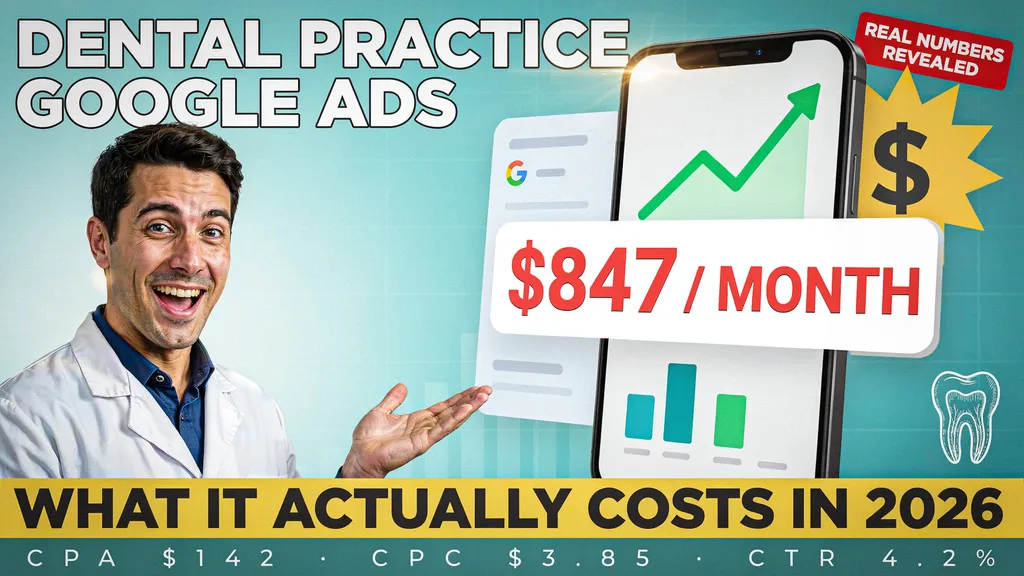
Dental Practice Google Ads: What It Actually Costs in 2026
June 4, 2026 · Joshua Filani
Dental is one of the most competitive — and most mismanaged — categories in local Google Ads. Most practices either spend too little to get results, bid on the wrong keywords, or have no idea what they are actually paying per new patient.
Unlike HVAC or plumbing, dental ads rarely produce same-day results. The decision cycle is longer. The patient might click your ad in January and schedule in March. Lifetime patient value is also different — a patient who stays with your practice for 10 years is worth $3,000-$8,000 in revenue, which changes the math on what you should be willing to pay per acquisition. This post covers what dental Google Ads actually cost in 2026, where most campaigns waste money, and how to tell if yours is performing at benchmark or not.
Is your site sending data it should not?
Send us your website and we will run a free, read-only check of what your tags and pixels send, then email you the results.
Free. Read-only. We change nothing on your site.Cost Per Patient Acquisition: What the Data Shows
The actual cost to convert a click into a booked, seated new patient for general dentistry runs $70-$150 per patient on well-managed campaigns. Dentplicity Poorly managed campaigns or those in highly competitive urban markets can push well above that range.
Specialty procedures have higher acquisition costs but also higher revenue per case. Implant and full-arch restoration campaigns typically run $200-$400 per acquired patient, and in the most competitive metro markets can push higher. DentalFast With implant case values of $4,000-$15,000 per treatment, those economics still work — but they require a landing page and follow-up system built specifically for implant-intent patients, not a general new-patient page.
Cost Per Click: Know Which Keywords You Are Actually Bidding On
Dental CPC ranges widely depending on the keyword type. General dentistry terms — "family dentist near me," "dentist accepting new patients" — run $3-$15 per click. High-intent emergency and specialty terms like "emergency dentist open now" or "dental implants [city]" run $8-$20 or more. KeyGrow
The keywords that look expensive per click are often your best performers per patient. Someone searching "dental implants Phoenix" has already decided they want implants — they are now choosing a provider. That is a high-intent, ready-to-book prospect. Someone searching "dentist" on broad match could be a future patient or could be a dental student researching programs. Broad match on limited budgets is where most dental campaigns waste the most money.
Local Service Ads for Dentists: $106-$119 Per Lead
Google's Local Service Ads (LSAs) for dental practices operate on a pay-per-lead model rather than pay-per-click. For dentists, LSA leads run $106-$119 per verified lead contact depending on market. Dentplicity
The advantage of dental LSAs is the Google Screened badge — a trust signal that standard search ads do not carry. For new patient acquisition where the prospect is choosing between several practices they have never visited, a verified Google badge has a measurable impact on conversion. The downside: less control over keyword targeting, and LSAs are generally more effective for general dentistry and emergency services than for specialty procedures where patients want to evaluate a specific provider's credentials before calling.
Monthly Budget: What You Actually Need
Most dental practices need a minimum of $1,500-$3,000/month in Google Ads spend to see consistent new patient volume. Competitive urban markets — Phoenix, Scottsdale, Tempe — where multiple group practices and DSOs are running well-funded campaigns typically require $3,000-$5,000+/month to generate meaningful results. DentalScapes
Below $1,000/month, a dental campaign does not get enough impressions on high-intent keywords to produce consistent bookings. The per-click cost on the keywords that actually convert (emergency dentist, implants, specific procedures) is high enough that a small budget gets exhausted on a handful of clicks before you can draw any conclusions about performance.
Why Most Dental Campaigns Underperform
Well-optimized dental Google Ads campaigns deliver 200-400% ROI on patient acquisition costs. Causal Funnel Most practices are not running well-optimized campaigns. The common failures:
- All traffic goes to the homepage. A general dentistry homepage does not convert implant-intent traffic, and vice versa. Each service category needs its own landing page with service-specific copy, before/after photos if relevant, and a single call to action.
- No follow-up on leads who do not book immediately. Dental decisions take longer than emergency home services. A patient who fills out a contact form and does not schedule in the next 48 hours is not lost — they just need follow-up. Most practices send one confirmation email and stop. The patient moves on to the practice that called them back.
- Broad match on a tight budget. Running broad match keywords with a $1,500/month budget means paying for clicks from dental students, suppliers, and researchers before you ever reach the patients you are trying to book. Use phrase and exact match on high-intent terms until you have the volume to manage broad match properly.
- Bidding on implants without implant follow-up. Implant patients research for weeks. A patient who clicks your implant ad and fills out a form in January needs a structured follow-up sequence over several weeks, not a one-time callback. Without follow-up, you are paying $200-$400 per lead and converting a fraction of what a proper nurture sequence would close.
Is your site sending data it should not?
Send us your website and we will run a free, read-only check of what your tags and pixels send, then email you the results.
Free. Read-only. We change nothing on your site.Google Business Profile: Often More Cost-Effective Than Ads for General New Patients
For general new patient acquisition, a strong Google Business Profile — 100+ reviews, 4.8+ average rating, recent photos, active posting — often generates new patient calls at a lower effective cost per patient than Google Ads. Dentx
Google Ads should layer on top of strong organic presence, not substitute for it. If your practice has 25 reviews and a 4.1 average rating, spending $3,000/month on Google Ads is papering over a credibility problem. Patients who click your ad will compare you to competitors who have more reviews and a higher rating — and many will choose the competitor even if your ad appeared first.
Fix the GBP first. Get to 80+ reviews. Then use Google Ads to capture the demand that organic rankings do not reach — particularly for specialty procedures and emergency situations where paid ads show above the local pack.
What to Set Up Before You Run Dental Google Ads
- A dedicated landing page for each service you are advertising. Emergency dental, implants, general new patients, and cosmetic should each have their own page.
- Call tracking on every phone number on every landing page. If you cannot tie calls back to specific campaigns, you cannot optimize spend.
- A follow-up sequence for form submissions. Not just a confirmation email — a structured outreach process over 7-14 days for prospects who did not book immediately.
- At least 50 Google reviews before spending aggressively on ads. The trust signal gap between 30 reviews and 100 reviews costs you conversions regardless of how good your ad copy is.
Our appointment scheduling agent handles follow-up and booking for dental and medical practices automatically — responding to form inquiries within minutes and moving prospects to a scheduled appointment without requiring front-desk staff to chase leads. The CRM automation agent handles the longer nurture sequences for specialty procedures where the patient needs multiple touchpoints before booking. If you want a specific read on why your current dental Google Ads spend is not producing the new patient volume you expected, book a free 24-hour audit and we will show you where the campaign is leaking.
Want to know what is actually broken on your site?
We audit your website, your Google Business Profile and your ad account, then send you a written report inside 24 hours. No pitch, no pressure — you get the plan whether you hire us or not. Start your free audit, see what we charge, or call (623) 343-3141 and talk to a person.
We are based in Phoenix and work with service businesses across the Valley — Mesa, Gilbert, Chandler, Tempe, Scottsdale and Phoenix.
Sources
- Dentplicity — Dental Patient Acquisition Cost Benchmarks (2026 Data)
- KeyGrow — How Much Does Google Ads Cost for Dentists? (2026 Data)
- DentalFast — Dental Ads Cost Guide 2026
- Dentx — Why Most Dentists Lose Money on Google Ads (2026)
- Causal Funnel — Google Ads for Dentists: 2026 Cost, Setup and ROI Guide
- DentalScapes — How Much Should a Dental Practice Spend on Google Ads?
Related reading
Everything Valley Does
AI marketing agents and full website builds — all under one roof.
Serving service businesses across the Phoenix Valley
Free tools
How Valley Can Help
We Help Businesses Like Yours Get More Leads — and Close More of Them
The Valley Marketing Group is a Phoenix-based marketing agency specializing in AI-powered lead generation, paid advertising, and web development for local service businesses.
- Google Ads & paid search — campaigns built to generate qualified leads, not just clicks
- AI phone receptionist — never miss a call or lead while you're on the job
- Website design & development — WordPress, Webflow, Shopify, WooCommerce
- SEO content & local search — rank for the searches your customers are already making
Google Ads Causing Trouble?
We'll look at your Google Ads account for free and show you where budget is being wasted, what needs fixing, and where the best opportunities are.
No generic report. No obligation.
Get My Free Audit